Have you ever asked yourself which ski area is the largest one in the world? I certainly have, and I've been trying to find an answer for a while. Turns out answering this is not as straightforward as it might sound. Every big resort has a number on its website, the numbers are measured in different ways, and some of them describe places you can't actually ski in one go. In this article I'll try to give a satisfying answer by showing different ways to measure and nominating the top contenders.
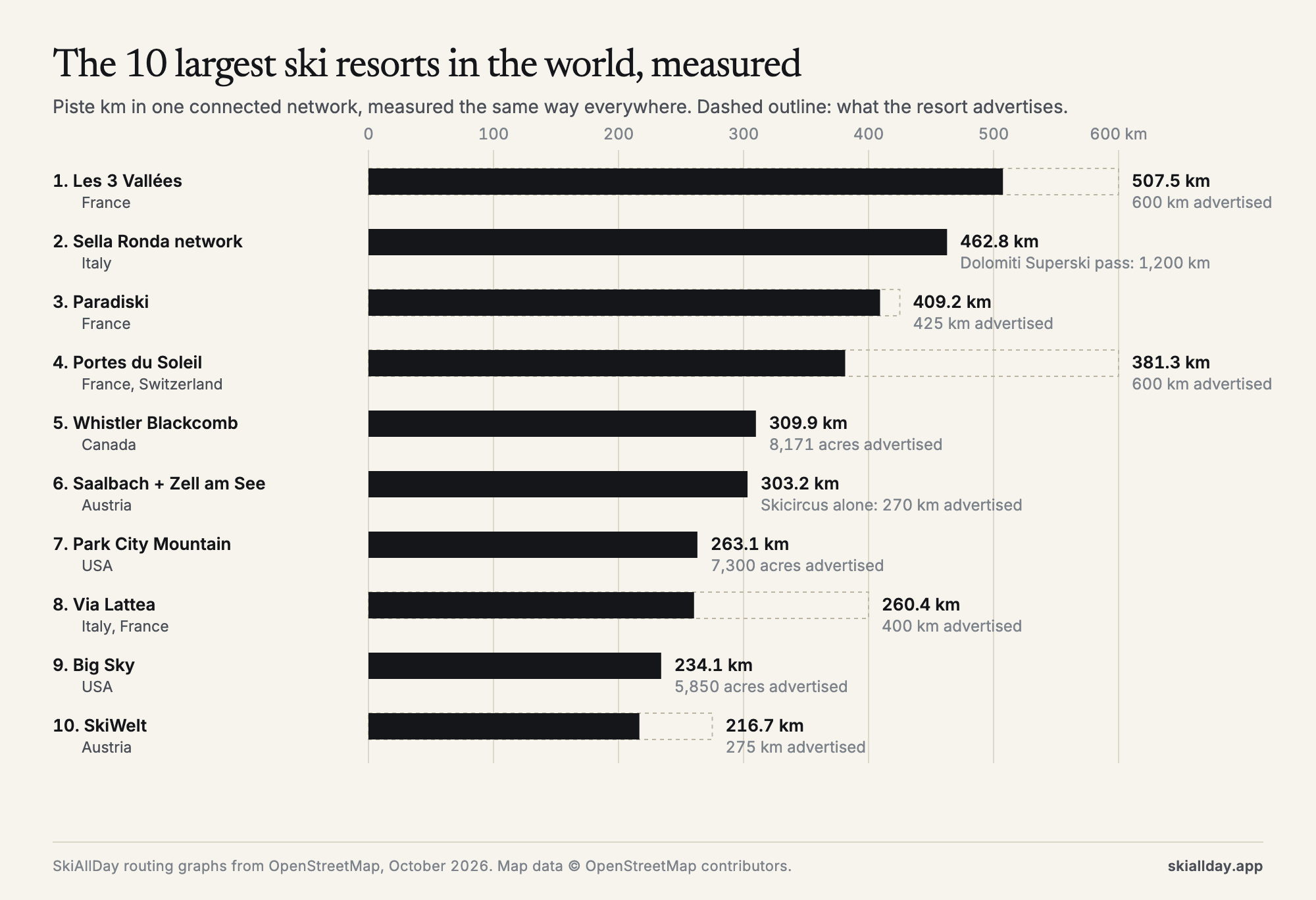
The short answer: Les 3 Vallées in the French Alps is the largest ski resort in the world. It advertises 600 km of pistes 1. Our own measurement finds 507.5 km, all of it in one ski area you can ski from end to end without taking your skis off. Second is the Sella Ronda network in the Dolomites at 462.8 km, then Paradiski at 409.2 km and the Portes du Soleil at 381.3 km.
Connected on skis, or just on one ski pass
The first thing we'll need to decide is what counts as one ski area, and the winner changes depending on how you decide it.
If it's everything you can ski on one ski pass, the winner is Dolomiti Superski in Italy, with 1,200 km of slopes across 12 ski areas and about 450 lifts on a single pass 2. In Austria, Ski amadé sells 760 km across 25 resorts in Salzburg and Styria on one pass 3. Those are real numbers about real passes, but a pass is a commercial agreement. Large parts of Dolomiti Superski are linked by road, and you'd need a car or a bus to get from Kronplatz to Cortina.
If it's one connected ski area, where you can get from any piste to any other on pistes and lifts and the odd short walk, the winner is Les 3 Vallées. That's the question I actually care about when I'm deciding where to spend a week, and it's the one this article answers. A third option, geographic clusters of ski areas, is out of scope for now.
To show how big the gap is: we measured every ski area on the Dolomiti Superski pass that the SkiAllDay app maps, 21 map files in all. Together they hold 917.8 km of graded piste, and that piste falls into 17 separate ski areas of a kilometre or more that no run, lift or short walk joins. The biggest is what I'll call the Sella Ronda network, at 462.8 km: the Sellaronda loop around the Sella group plus everything connected to it, which reaches as far as Cortina and the Alpe di Siusi. The second biggest is Kronplatz at 76.6 km.

What counts as connected
Two pistes are in the same ski area if a skier can get from one to the other on pistes and lifts, or by walking up to 500 metres between the nearest lift station or piste end on each side. The 500 metres is an arbitrary threshold I set for this ranking, because it feels like a distance you could walk even in uncomfortable ski boots.
The walking part matters more than you'd expect. At Ski Arlberg, only about half of the lift exits connect directly to the start of a piste. The rest need a few metres of walking across a flat top station or a road. If you leave those short walks out, the network falls apart at half its junctions, and the map no longer matches what a skier actually experiences.
Lifts of every kind count, including the long ones. Paradiski exists because of the Vanoise Express, a double-decker cable car that has crossed the valley between La Plagne and Les Arcs since 2003 4. Zermatt connects to Breuil-Cervinia and Valtournenche over the Italian border, so the three form one ski area of 210.4 km.
Buses and trains don't count. A bus runs on a timetable, gets stuck in traffic and stops running in the late afternoon, and that changes what kind of day you can plan. Aspen Snowmass is the clearest case: four mountains on one ticket, connected by bus and by nothing else, so they stay four ski areas here.
The Portes du Soleil is where the walking distance decides the answer. It advertises 600 km across 12 resorts 5, and its two halves meet in Morzine, where the operator runs a free shuttle train between them. No piste or lift joins them, but the nearest piste end and lift station on either side are 411 m apart. At 150 m the Portes du Soleil is a 271.6 km loop through Avoriaz, Châtel and the Swiss resorts of Champéry, Les Crosets and Morgins, with Les Gets and Morzine's Pleney side as a separate 91.5 km. Allow the walk through Morzine and they're one ski area of 381.3 km, which moves the Portes du Soleil from sixth place to fourth.

How much the walk matters
The two walks that matter most at the top of the ranking both fall inside 500 metres. One is the 411 m through Morzine. The other is in Ortisei, where the gondola up to the Alpe di Siusi leaves 489 m from the one up to Seceda, and the town has built a tunnel of escalators and moving walkways to its Seceda station 6.
Here's how the top of the ranking moves if you allow a longer or shorter walk.
| Walk allowed | First | Second | Third | Fourth |
|---|---|---|---|---|
| 150 m | Les 3 Vallées, 507.5 km | Paradiski, 409.2 km | Sella Ronda network, 395.4 km | Whistler Blackcomb, 307.5 km |
| 300 m | Les 3 Vallées, 507.5 km | Paradiski, 409.2 km | Sella Ronda network, 398.0 km | Whistler Blackcomb, 309.7 km |
| 500 m | Les 3 Vallées, 507.5 km | Sella Ronda network, 462.8 km | Paradiski, 409.2 km | Portes du Soleil, 381.3 km |
| 1,000 m | Les 3 Vallées, 507.5 km | Sella Ronda network, 462.8 km | SkiWelt with KitzSki, 440.8 km | Paradiski, 409.2 km |
| 2,000 m | Park City with the Cottonwood resorts, 518.2 km | Les 3 Vallées, 507.5 km | Espace Diamant with Megève, 504.5 km | Sella Ronda network, 496.2 km |
Every distance is the straight line between the nearest lift station or piste end on each side, measured on the same SkiAllDay routing graphs as the rest of this article.
Les 3 Vallées is first at every distance up to a kilometre, so the answer to this article's question holds. Below it, the walk moves things. At 500 m the Alpe di Siusi joins the Sella Ronda network and the two halves of the Portes du Soleil join each other. At 1 km SkiWelt joins KitzSki, whose nearest piste or lift is 869 m away, and through it St. Johann in Tirol. At 2 km Park City joins Alta, Snowbird, Brighton and Solitude across the Wasatch ridge, and Espace Diamant joins Megève, Les Contamines and Saint-Gervais. Some of those 2 km joins cross a ridge with no lift or piste on it at all, Park City to Brighton among them, which is why the line has to be drawn well before them.
Measuring a piste
The second question is how long a piste is. A piste is a strip of snow, often 50 metres wide or more, and the length depends on which line down it you measure.
The usual method is to measure along the centre line. A skier who turns covers more distance than that, so you could argue for the longest line a skier might plausibly take. Christoph Schrahe, a German cartographer who measured about 80 ski areas with piste maps and Google Earth in 2013, accepted figures up to 30% above the centre line for exactly that reason 7. Even with that allowance, 38 of the 56 biggest ski areas in France advertised more than his limit, and three claimed more than double what he measured 8. He also found resorts counting the same stretch of snow twice when a red and a blue piste share it, and adding ski routes into the piste total. Silvretta Montafon advertised 155 km of "pistes and marked routes" where he measured 116 km 7. The Austrian cable-car operators' association agreed on common standards for counting piste kilometres after his study came out 7.
Les 3 Vallées came out on top of every edition of his ranking I could find, with 493 km in 2013 9, 542 km in 2016 8 and 543 km in 2019 10. That's three different measurements of the same mountain, and none of them reached the 600 km on the brochure.

The SkiAllDay measure
Luckily we have our own measure, built on the map the SkiAllDay app routes on, and it's the same rule for every resort.
The app builds a routing graph from OpenStreetMap for each of the 1,310 ski areas it covers. For this article I take each ski area as defined above and add up the length of every graded piste in it, each stretch of snow counted once along the line mappers drew for it, which is close to the centre line. Ski routes, lifts and walks connect the pieces but add nothing to the length.
The app's map files don't always follow the mountains. Some areas are split across several files and some files overlap, so the measurement joins files wherever their pistes meet and counts a piste found in two files once. The Sellaronda's file, for example, stops at the top of the Alba-Col dei Rossi cable car without the Ciampac pistes it serves, and those come from the next file over.
That makes our figures conservative. They're a floor, and they'll usually sit below what the resort advertises. What they give you is a fair comparison: Les 3 Vallées and Big Sky are measured with exactly the same method. As a cross-check, OpenSkiStats, an independent project that measures the same OpenStreetMap data, counts 552.6 km of downhill runs in Les 3 Vallées 11. It includes ski routes, which we leave out, and works from a newer copy of the map. With ski routes included, our graph has 521.1 km.
The 10 largest ski resorts in the world, measured
| # | Ski area | Country | Measured, connected | Advertised |
|---|---|---|---|---|
| 1 | Les 3 Vallées | France | 507.5 km | 600 km 1 |
| 2 | Sella Ronda network | Italy | 462.8 km | part of Dolomiti Superski's 1,200 km 2 |
| 3 | Paradiski | France | 409.2 km | 425 km 12 |
| 4 | Portes du Soleil | France, Switzerland | 381.3 km | 600 km 5 |
| 5 | Whistler Blackcomb | Canada | 309.9 km | 8,171 acres 13 |
| 6 | Saalbach and Zell am See | Austria | 303.2 km | 270 km for the Skicircus alone 14 |
| 7 | Park City Mountain | USA | 263.1 km | 7,300 acres 15 |
| 8 | Via Lattea | Italy, France | 260.4 km | 400 km 16 |
| 9 | Big Sky | USA | 234.1 km | 5,850 acres 17 |
| 10 | SkiWelt Wilder Kaiser-Brixental | Austria | 216.7 km | 275 km 18 |
Just outside the top 10: Zermatt-Cervinia at 210.4 km (360 km advertised), Ski Arlberg at 209.6 km (300 km) and Tignes-Val d'Isère at 209.5 km (300 km).
Measured: graded piste in one connected ski area, with pieces joined by a walk of up to 500 m, from SkiAllDay's routing graphs of OpenStreetMap, October 2026. Resort pages measure each map file on its own, so some figures there differ.
The gap between first and second is 44.7 km, and Les 3 Vallées stays first whichever walking distance up to a kilometre you allow.
The Sella Ronda network in second place is the name you won't find on a piste map. The Sellaronda itself, the loop around the Sella group through Val Gardena, Alta Badia, Arabba and Val di Fassa, has 284.5 km. It doesn't stop there. Ciampac above Alba, the Marmolada, and Lagazuoi with the Cinque Torri all connect to it by piste or lift, and since the Cortina Skyline gondola opened, so do Cortina's Tofane 19. The Alpe di Siusi joins through the 489 m walk in Ortisei. All of it is on the Dolomiti Superski pass.
Saalbach and Zell am See are joined by the zellamseeXpress gondola, which has run from Viehhofen in the Skicircus up to the Schmittenhöhe since December 2019 20. That's a lift, so the two count as one ski area at any walking distance.
Whistler Blackcomb is the result I'd treat with the most caution, for reasons a later section goes into. By acreage it's the largest resort in North America either way.
Park City's figure depends on a boundary we drew ourselves. OpenStreetMap records Park City and neighbouring Deer Valley as a single ski area, although they're separate resorts on separate passes with no piste between them, so we split the lifts by operator before measuring. For the same reason Big Sky doesn't include the Yellowstone Club next door, a private club you can't buy a ticket for.
The closest any resort comes to its own number is Paradiski, at 4% under. The Portes du Soleil and Via Lattea are furthest from theirs, about 35% under.

Comparing North America with Europe
Put the ten side by side at the same scale, as in figure 5, and the three North American resorts look small next to the European ones, although they have as much piste as several of them. Whistler Blackcomb has 309.9 km of piste, and the two furthest points of its network are 9.6 km apart. Les 3 Vallées spreads its 507.5 km over 21.4 km, and even SkiWelt in tenth place covers 14.7 km.
| # | Ski area | Piste | End to end | Lift line |
|---|---|---|---|---|
| 1 | Les 3 Vallées | 507.5 km | 21.4 km | 169.8 km |
| 2 | Sella Ronda network | 462.8 km | 40.7 km | 197.2 km |
| 3 | Paradiski | 409.2 km | 20.8 km | 118.8 km |
| 4 | Portes du Soleil | 381.3 km | 23.7 km | 135.7 km |
| 5 | Whistler Blackcomb | 309.9 km | 9.6 km | 43.3 km |
| 6 | Saalbach and Zell am See | 303.2 km | 25.9 km | 96.2 km |
| 7 | Park City Mountain | 263.1 km | 10.8 km | 47.6 km |
| 8 | Via Lattea | 260.4 km | 20.6 km | 77.0 km |
| 9 | Big Sky | 234.1 km | 8.7 km | 34.4 km |
| 10 | SkiWelt | 216.7 km | 14.7 km | 72.4 km |
End to end: the straight-line distance between the two furthest points of the piste network. Lift line: the length of every lift, each section counted once. Both from the same routing graphs as the ranking.
The two continents built big ski areas differently. In the Alps, a big ski area is a chain of villages joined by lifts across several valleys, and a day there is a journey: you can ski from Courchevel to Val Thorens and back. A big North American resort is usually one or two mountains above one base, with bowls, glades and tree skiing between the marked runs.
That difference means a kilometre figure for a North American resort can be read two ways, and both readings hold at the same time.
The first reading says the kilometres undercount it. OpenStreetMap records runs as lines, the same way a piste map draws them. A European piste is a groomed strip, so a line describes it well. In a bowl at Whistler or Big Sky you can ski almost anywhere between the lines, and that terrain is in no kilometre figure, ours included.
The second reading says they overcount it. Where a bowl has several named runs, each one gets its own line down the same open slope, so the same snow is counted once per line. Our data shows this happening. If you draw a 200 m wide strip along every mapped run, Whistler Blackcomb, Park City and Big Sky have 9.5 to 10.1 km of piste in each square kilometre of that ground, and the seven European areas 6.9 to 8.3 km. On the same amount of mountain, the North American resorts log about a quarter more piste. Whistler Blackcomb's 309.9 km against skiresort.info's estimate of 200 km 21 is the clearest case.
Those same strips also explain the acres North American resorts advertise. At Whistler Blackcomb they cover 7,613 acres, at Park City 6,869 and at Big Sky 6,042, close to the 8,171, 7,300 and 5,850 acres the three resorts publish 131517. Most European resorts don't publish acres, so there's no like-for-like number on the other side of the Atlantic.
Which reading matters more changes from resort to resort, and no piste measure can settle it, ours included. That's why the next section ranks the same ski areas by something nobody has to draw: their lifts.
The largest ski areas by lift kilometres
A lift is a cable between two stations. Nobody has to decide how wide it is or how many lines go through a bowl, so lift length is the least ambiguous thing on a ski map. Adding up every lift in one connected ski area, with each section of a lift counted once, gives a second ranking that doesn't depend on how anyone draws a run. I measured it for all 54 ski areas in the SkiAllDay app with 100 km or more of downhill, not only the top 10 above.

| # | Ski area | Country | Lift line | Mapped lifts | Piste |
|---|---|---|---|---|---|
| 1 | Sella Ronda network | Italy | 197.2 km | 246 | 462.8 km |
| 2 | Les 3 Vallées | France | 169.8 km | 142 | 507.5 km |
| 3 | Portes du Soleil | France, Switzerland | 135.7 km | 165 | 381.3 km |
| 4 | Paradiski | France | 118.8 km | 164 | 409.2 km |
| 5 | Saalbach and Zell am See | Austria | 96.2 km | 107 | 303.2 km |
| 6 | Ski Arlberg | Austria | 82.4 km | 91 | 209.6 km |
| 7 | Tignes-Val d'Isère | France | 80.2 km | 87 | 209.5 km |
| 8 | Via Lattea | Italy, France | 77.0 km | 88 | 260.4 km |
| 9 | Zermatt-Cervinia | Switzerland, Italy | 77.0 km | 65 | 210.4 km |
| 10 | 4 Vallées | Switzerland | 75.4 km | 78 | 161.9 km |
Lift line: the length of every lift in the ski area, each section counted once, magic carpets included. Mapped lifts: lifts as OpenStreetMap records them, which can differ from an operator's own count. Piste: as in the first ranking.
Here the Sella Ronda network comes first, 27.4 km ahead of Les 3 Vallées. Looping around the Sella group and reaching out to Cortina and the Alpe di Siusi takes a lot of lift. Ski Arlberg, Tignes-Val d'Isère, Zermatt-Cervinia and the 4 Vallées join the top 10, and all three North American resorts drop out of it. Park City is the first of them, in 24th place with 47.6 km. Whistler Blackcomb is 28th with 43.3 km and Big Sky 36th with 34.4 km.

Figure 7 puts the two rankings against each other. The median European area gets 3.0 km of piste out of each kilometre of lift, and the median North American resort 5.5 km. Whistler Blackcomb gets 7.2 km, Big Sky 6.8 and Park City 5.5, and smaller resorts like Sun Peaks and Silver Star more than 12.
Lift kilometres have a bias of their own, toward Europe. Alpine areas link their valleys with long gondolas and funiculars and put a lift on almost every slope, while a North American resort often serves a whole bowl from one chairlift. Some of that gap is the second reading above, runs drawn close together, and some of it is a real difference in how the two continents build lifts. A ranking by lift kilometres measures the lift network, which is a good stand-in for the size of a ski area but not the same thing.

So I'd read the two rankings together. Les 3 Vallées has the most piste and the Sella Ronda network the most lift, and those two are the largest ski areas in the world on every measure here. Below them, the piste ranking flatters North American resorts whose runs are drawn close together, and the lift ranking flatters European areas whose valleys are joined by long gondolas. If you want to cover distance and ski into a different village every day, the Alps win either way. If you want a lot of skiing within reach of one base, Whistler Blackcomb packs more piste into its span than any other resort here.
The largest ski resort in Europe
Les 3 Vallées, with the Sella Ronda network in the Dolomites second and Paradiski third.
Country by country, among the resorts we've measured so far:
- France: Les 3 Vallées, 507.5 km
- Italy: the Sella Ronda network, 462.8 km
- Austria: Saalbach and Zell am See, 303.2 km, ahead of SkiWelt at 216.7 km and Ski Arlberg at 209.6 km
- Switzerland: Zermatt, 210.4 km including the Italian side. The largest network entirely inside Switzerland is the 4 Vallées around Verbier at 161.9 km.
The largest ski resort in North America and the US
American and Canadian resorts advertise acres rather than kilometres, for the reasons in the comparison above.
By acreage, Whistler Blackcomb is the largest in North America with 8,171 acres 13, and Park City is the largest in the US with 7,300 acres 15. Powder Mountain in Utah lists 5,000 acres, but that total includes terrain reached by bus and on foot as well as by lift 22.
By our measure the order is the same: Whistler Blackcomb 309.9 km, Park City 263.1 km, then Big Sky at 234.1 km.
The largest ski pass areas
If one ticket is what you're after, the answers are different again.
- Dolomiti Superski: 1,200 km advertised across 12 ski areas 2, 917.8 km measured in 17 separate ski areas
- Ski amadé: 760 km advertised across 25 resorts 3. We haven't measured it yet.
- Portes du Soleil: 600 km advertised 5, 396.3 km measured, of which 381.3 km is one ski area
They're great passes for a road trip, but only the Portes du Soleil comes close to being one ski area.
Frequently asked questions
What is the largest ski resort in the world?
Les 3 Vallées in France, connecting Courchevel, Méribel, Val Thorens, Les Menuires, Saint-Martin-de-Belleville, Orelle and Brides-les-Bains. It advertises 600 km of pistes and measures 507.5 km as a single connected ski area.
Is Dolomiti Superski bigger than Les 3 Vallées?
As a ski pass, yes: 1,200 km across 12 ski areas. As a ski area, no. Its pistes form 17 separate ski areas, and the largest of them, the Sella Ronda network around the Sellaronda, measures 462.8 km, 44.7 km less than Les 3 Vallées.
What is the largest ski resort in Europe?
Les 3 Vallées. The Sella Ronda network in the Dolomites is second at 462.8 km and Paradiski third at 409.2 km.
What is the largest ski resort in North America?
Whistler Blackcomb in British Columbia, with 8,171 skiable acres and 309.9 km of piste by our measure.
What is the largest ski resort in the US?
Park City Mountain in Utah, with 7,300 skiable acres and 263.1 km of piste by our measure.
How far can you walk and still be in the same ski area?
For this ranking, 500 metres between the nearest lift station or piste end on each side. That joins the two halves of the Portes du Soleil through Morzine (411 m) and the Alpe di Siusi to the Sellaronda through Ortisei (489 m). Buses and trains never count.
Can you compare the size of North American and European ski resorts?
Only roughly. European resorts advertise kilometres of piste and North American ones acres. Kilometres miss the open terrain between North American runs, and they also count one bowl several times when several named runs go down it. Lift kilometres avoid the drawing question but favour Europe's long valley gondolas. By our measure Whistler Blackcomb has 309.9 km of piste and 43.3 km of lift line in a network 9.6 km end to end, while Les 3 Vallées has 507.5 km of piste and 169.8 km of lift line spread over 21.4 km.
Which ski area has the most lifts?
By length, the Sella Ronda network in the Dolomites: 197.2 km of lift line in one connected ski area, each section counted once. Les 3 Vallées is second with 169.8 km and the Portes du Soleil third with 135.7 km. By number too, the Sella Ronda network has the most mapped lifts of the 54 areas we measured, 246.
Why are measured piste lengths shorter than the advertised ones?
Resorts usually measure generously: they add ski routes, count a shared stretch of snow once for each piste that uses it, and round up. A measurement along the centre line of each piste, counting every stretch once, comes out lower almost everywhere. Among the big resorts, Paradiski (4% under) and the Skicircus Saalbach (about 10% under) come closest to their own figures.
References
- 1. ^ a b Les 3 Vallées in figures
- 2. ^ a b c Dolomiti Superski
- 3. ^ a b Ski areas in Ski amadé
- 4. ^ Vanoise Express
- 5. ^ a b c Skiing in Les Portes du Soleil
- 6. ^ Sankt Ulrich (Ortisei)
- 7. ^ a b c Der Bluff mit den Pistenkilometern
- 8. ^ a b French ski resorts 'lying about how long their pistes are'
- 9. ^ Les étranges calculs des stations de ski pour gonfler leur taille
- 10. ^ List of world's biggest ski areas uses new measuring formula (but 3 Valleys still the biggest)
- 11. ^ OpenSkiStats: ski areas
- 12. ^ A domain like no other
- 13. ^ a b c Mountain info
- 14. ^ Skicircus Saalbach Hinterglemm Leogang Fieberbrunn
- 15. ^ a b c Mountain stats, elevation and snowfall
- 16. ^ Vialattea ski area: 400 km of slopes in the Alps
- 17. ^ a b Mountain information
- 18. ^ SkiWelt facts, winter 2025/26
- 19. ^ GD10 Cortina Skyline I + II
- 20. ^ Grand opening of zellamseeXpress
- 21. ^ Ski resort Whistler Blackcomb
- 22. ^ Explore the terrain at Powder Mountain