Most of what surprises North American skiers on a first trip to the Alps is small: a piste colour that means something different, a lift ticket that costs a third of what they're used to, a lunch that takes an hour and a half. The big difference is scale: a big ski area in the Alps is a network of villages joined by lifts across several valleys, and you can spend a whole day skiing away from where you're staying and still have to get back before the lifts close.
This guide covers what's different, country by country, with numbers measured the same way on both sides of the Atlantic. The measurements come from the routing graphs the SkiAllDay app navigates on, built from OpenStreetMap: 71 ski areas in Europe and 22 in the US and Canada that have a full guide on this site.
The short version: skiing in Europe is cheaper per day: a day ticket at the big ski areas of the Alps costs $74 to $141, against $279 to $356 at the big US resorts. The ski areas are larger and join more villages. A European red run is about as steep as an American blue square, and black runs make up 10% of the downhill kilometres in Europe against 36% in North America. Off the marked piste nothing is patrolled or controlled for avalanches, and in Italy a helmet and liability insurance are required by law. The hardest new skill is navigation: one route from Val Thorens to Courchevel passes 33 junctions in 13.5 km of skiing.
Skiing in Europe vs the US: the main differences
| Topic | In the Alps | In the US and Canada |
|---|---|---|
| Size | Large areas link several villages and valleys by lift | One or two mountains above one base |
| Day ticket | $74 to $141 at the window | $279 to $356 at the big resorts |
| Run grades | Blue, red, black; green in France | Green circle, blue square, black diamond, double black |
| Hardest runs | 10% of piste is black | 36% is black diamond or harder |
| Off the piste | Unpatrolled, no avalanche control, no boundary rope | Inbound terrain is patrolled; backcountry starts at a gate |
| Lifts | 17% of lift km is T-bars and platters, 38% gondolas and cable cars | 80% chairlifts |
| Altitude | Bases at 600 to 1,800 m, tops up to 3,883 m | Colorado bases at 2,100 to 2,960 m |
| Lunch | Table service in mountain huts | Cafeterias at the base and summit lodges |
| Language | English widely spoken in Austria, less so in France and Italy | English |
Measured figures: the 71 European and 22 North American ski areas with a SkiAllDay guide. Prices and altitudes: the guides charted in figures 6 and 7.
The rest of this guide takes these one at a time.
A ski area in the Alps is a network of villages
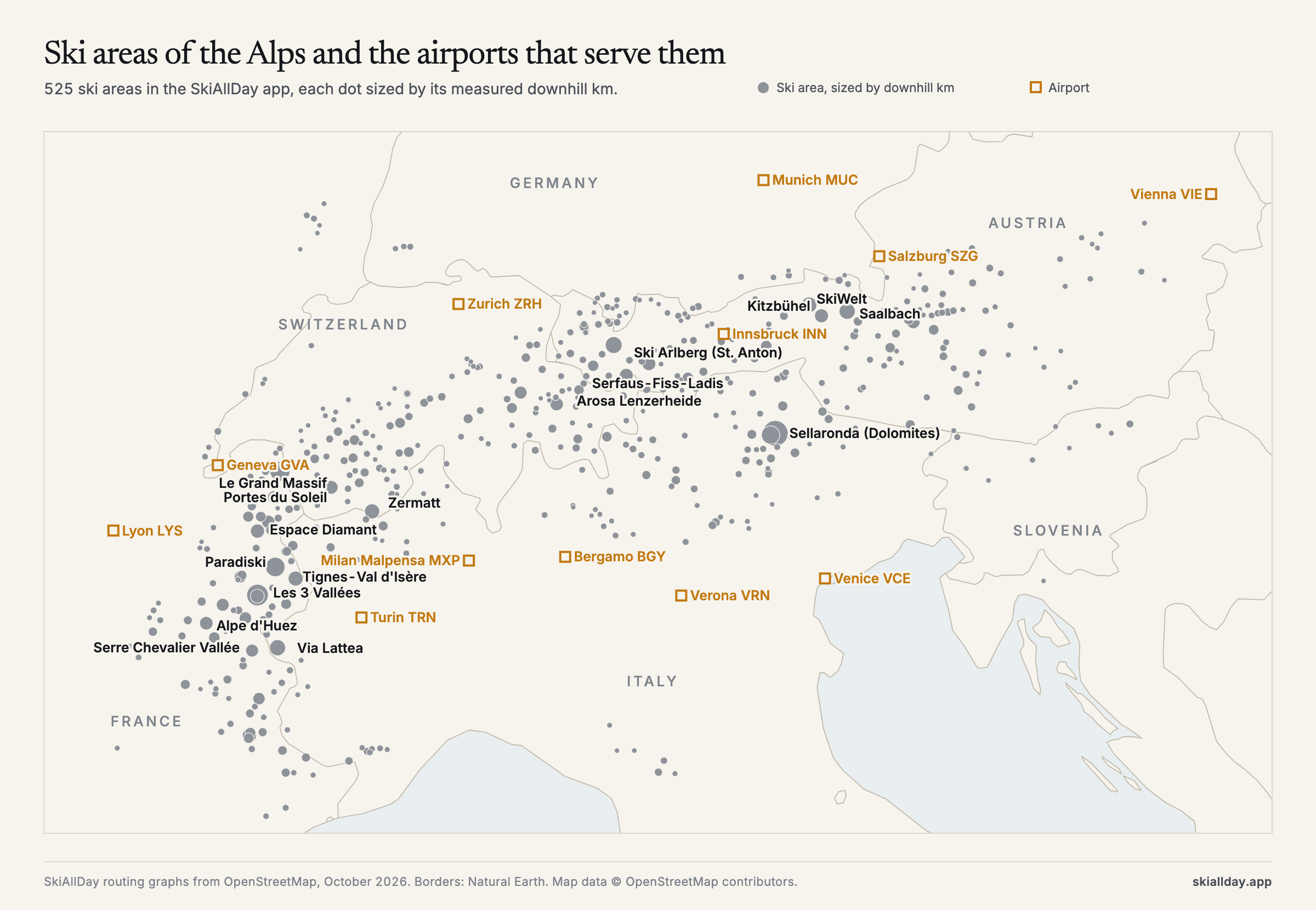
The best-known names in the Alps are often several resorts sold on one ticket and joined by lifts. Les 3 Vallées connects Courchevel, Méribel, Val Thorens, Les Menuires, Saint-Martin-de-Belleville, Orelle and Brides-les-Bains. Ski Arlberg joins St. Anton, Lech and Zürs. The Sellaronda is a loop through four valleys of the Dolomites. I measured these networks for the largest ski resorts in the world, and the Alps hold nine of the twelve biggest.
Figure 2 draws Les 3 Vallées next to Vail, one of the largest resorts in the US, at one scale. Les 3 Vallées has 507.5 km of piste in one connected network, 21.4 km from one end to the other. Vail has 196.1 km over 10.8 km, and all of it drains back to one town.

That difference changes how a ski day works. In Vail you can ski all day without ever being far from your car. In Les 3 Vallées you can have lunch in a different valley and need an hour and four lifts to get home, and the connecting lifts close in the late afternoon. Miss the last one and the way back is a long taxi ride round the mountain by road.
France has more of these networks than anywhere. Of the ski areas in the SkiAllDay app, 19 in France have 100 km or more of downhill runs, against 14 in the whole of the United States.
Piste colours, and how hard a European red really is
Every country in Europe grades pistes blue, red and black, and France, Spain and a few others add green for the gentlest beginner slopes 1. North America uses the green circle, blue square, black diamond and double black diamond 1. The colours overlap, which is where the confusion comes from: a European blue is an easy run, an American blue is an intermediate one.
The grades in our routing graphs come from OpenStreetMap, which records both systems on one scale: easy, intermediate, advanced and expert. So I could measure how steep each grade is on each continent. Figure 3 gives the mean gradient of every piste of each grade, weighted by length.

- An easy run averages 15.0% in Europe and 12.8% in North America. A European blue is a little steeper than a green circle.
- A European red averages 21.7%, an American blue square 20.9%. They are the same grade in practice.
- A European black averages 29.3%, a black diamond 31.8%.
A piste is graded by its steepest stretch, so the average understates how steep the hardest part of a black run gets. It's still the fairest comparison of what a grade means across a whole mountain. If you ski blue squares comfortably at home, you'll ski European reds, and the blacks will feel like black diamonds.
What's very different is how much of each there is. Figure 4 splits the piste kilometres of every guide by grade. In Europe, 44% is easy, 36% intermediate and 10% black, and another 10% is ski route. In North America, 25% is easy, 38% intermediate and 36% black diamond or harder. Much of that gap is terrain the two continents treat differently. A North American resort maps its mogul runs, glades and bowls as named trails inside the boundary. In the Alps, the same kind of terrain is either off-piste or a ski route.

A ski route is the grade North Americans don't have. In Austria and Switzerland it's marked on the map and on the mountain, usually in yellow or orange, and protected from avalanches, but it isn't groomed or checked by patrollers 21. In our European guides, 10% of the downhill length is ski route.
Off-piste, insurance and the rules
There's no boundary rope in the Alps. The edge of a piste is a line of poles, and between and beyond them the mountain is open. Nobody controls that terrain for avalanches or sweeps it at the end of the day, and Switzerland's avalanche research institute puts the responsibility plainly: away from the secured pistes, everyone answers for their own safety 3. Most avalanche accidents happen there 3.
Avalanche danger is published every day on the European scale of five levels, from 1 (low) to 5 (very high) 4. Level 3, considerable, is forecast for around 30% of the winter, and about half of all avalanche deaths happen at that level 4. If you want to ski off-piste, hire a mountain guide. A guide knows the terrain, reads the bulletin for a living and carries the rescue gear.
Rescue costs money in most of the Alps, on the piste as well as off it. Carré Neige, the insurance sold with lift tickets in many French resorts, puts the average cost of a piste rescue at €475 and of a helicopter evacuation at €3,780; its cover costs €3.50 a day 5. In Switzerland a Rega helicopter mission averages around CHF 4,500, and the rescued skier or their insurer pays 6. Visitors can become Rega patrons for CHF 40 a year, after which Rega may waive the costs that insurance doesn't cover 6. Before you go, check whether your travel insurance covers skiing and helicopter rescue.
Italy has its own rules. Third-party liability insurance has been compulsory on Italian pistes since 1 January 2022, and resorts must sell it with the ticket 78. Since August 2025 a helmet is compulsory at every age, not only for children, with fines of €100 to €150 8. Skiing under the influence of alcohol is fined €250 to €1,000 8.
Finding your way around a European ski area
Navigation is the skill a North American skier most underestimates in the Alps. A big area is a web of valleys rather than one mountain, the trail map is a painted panorama rather than a map to scale, and a wrong turn can take you down into the wrong valley.
To show how many choices a day contains, I asked the SkiAllDay routing engine for the quickest way from Val Thorens to Courchevel that avoids black runs. Figure 5 is the result. It takes four lifts, Plein Sud, the Funitel 3 Vallées and the two sections of the Pas du Lac gondola, and 13.5 km of blue and red piste. On the way it passes 33 junctions where another piste or lift branches off. The way back takes four different lifts and passes 25 junctions.

Signposting in the Alps is good but terse. Each piste has a colour and usually a number or a name, and the posts at a junction point to the next lift or the next village by name. That works once you know that "Saulire" is the ridge between Méribel and Courchevel, and it's no help when you don't. A few habits make it easier:
- Know the name of the lift that brings you home and the time it closes. Ask at the ticket office or check the resort's app, since closing times change through the season.
- Read the trail map for valleys and lift names, not distances. Panoramas compress and stretch the terrain to fit a painting, so two runs that look the same length on the map can differ by kilometres.
- Watch the grade of the connecting run, not only the one you're on. The quickest link between two valleys is often a red or a black, and the blue alternative may need an extra lift.
- Above the treeline, flat light can hide the piste edges completely. Stay on marked pistes when the cloud comes in.
This is the problem SkiAllDay was built for. The app routes across the same lift and piste graph as the figures in this guide, for 1,310 ski areas, and holds the route to the hardest grade you're willing to ski. Set it to blues only, or blues and reds, and it finds the way between two villages, two lifts or the hut where you're meeting friends, naming each lift and piste as the signs on the mountain do. It also records your day and matches it back to the runs and lifts you took. It's on the App Store.
Lifts, queues and T-bars
European lifts differ in two ways you'll notice on day one. More of them are gondolas and cable cars, because a valley-to-valley link often needs one: in our guides 38% of European lift length is gondolas, cable cars and funiculars, against 16% in North America. And more of them are surface lifts. T-bars and platters make up 17% of European lift length and 4% of North American. On glaciers and in high bowls a T-bar is often the only lift, so it's worth learning to ride one: keep your skis in the track, lean back against the bar rather than sitting on it, and let go at the top where the track flattens.
Lift tickets in the Alps are usually a card with a chip you keep in a pocket, and the gates read it as you walk through. Queues at a busy lift form a crowd funnelling into the turnstiles rather than a roped maze with a singles line, and on a February weekend it pays to start early.
Altitude, snow and the best time to go
Ski areas in the Alps start lower and finish higher than most people expect. Figure 6 sets the base and top of twelve Alpine areas against ten in North America. The Colorado resorts start at 2,100 to 2,960 m, higher than the top of Kitzbühel at 2,000 m or SkiWelt at 1,869 m. If you've felt the altitude on a first day in Breckenridge, most Alpine villages are a kilometre or more lower. The big Alpine areas then run up to glaciers: Zermatt goes from 1,620 m to 3,883 m, a vertical drop of 2,263 m, the largest in the chart.

Lower bases mean less reliable snow at the bottom of the mountain. The high, glacier-topped areas such as Zermatt, Saas-Fee, Tignes-Val d'Isère and Sölden open earliest and are the safe choice in December or April. Val Thorens opens on 21 November 2026 and closes on 2 May 2027, while the whole of Les 3 Vallées is only connected from 5 December to 18 April, according to its guide.
January and March are the best months for most trips. January has the coldest snow and the emptiest slopes after the New Year week. March has longer days and the deepest base. February is the busiest month, because European school holidays fall in it: France's three holiday zones alone cover 6 February to 8 March 2027 between them 9.
What a ski trip to Europe costs
Lift tickets are where the difference shows most. Figure 7 converts the price of one adult day ticket at 23 resorts into US dollars. The big US resorts charge $279 to $356 at the window. The large areas of the Alps charge $74 to $95 in France, Austria and Italy, and $96 to $141 in Switzerland 10. A six-day pass for all of Les 3 Vallées, the largest ski area in the world, costs €421, according to its guide.

The US prices are walk-up prices on busy dates, and few people pay them. Buy online in advance, or use a season pass, and a US day costs much less. Both big passes now cover part of the Alps:
- The Epic Pass covers ten European destinations 11. It gives unlimited days at Andermatt-Sedrun-Disentis and Crans-Montana, seven consecutive days at Les 3 Vallées and Skirama Dolomiti, and three to five days at Verbier 4 Vallées, Ski Arlberg, Saalbach with Zell am See-Kaprun, the Zillertal, Silvretta Montafon and Sölden. Ski Arlberg needs a stay booked with a partner hotel. At Les 3 Vallées, its guide notes that you need the physical pass card and photo ID at the ticket office.
- The Ikon Pass for 2026/27 covers nine European destinations, with up to seven days at each on the full pass and five on the Base pass 12: Chamonix, Megève, Zermatt, St. Moritz, Kitzbühel, Ischgl, Dolomiti Superski, Valle d'Aosta and Grandvalira in Andorra.
Beyond tickets, lunch on the mountain is a sit-down meal with table service in most of the Alps, and a long one. Hotels in Austria and Italy usually include dinner in the room rate, which is called half board. In France, apartments rented by the week are common, and ski shops in every village rent skis and boots by the day or the week, so there's no need to fly with your own.
The ski countries of Europe compared
| Country | Ski areas in the app | With 100 km or more | English, EF rank of 123 | Currency |
|---|---|---|---|---|
| France | 140 | 19 | 38th | euro |
| Austria | 158 | 12 | 3rd | euro |
| Switzerland | 122 | 6 | 30th | Swiss franc |
| Italy | 143 | 4 | 59th | euro |
| Germany | 30 | 0 | 4th | euro |
| United States | 238 | 14 | US dollar |
Ski areas: every area the SkiAllDay app covers in that country, by its downhill km in OpenStreetMap; a cross-border area counts in each country it touches. English: EF English Proficiency Index 2025 13.
France has the largest ski areas in the world, and most of them sit in Savoie and Haute-Savoie: Les 3 Vallées, Paradiski, Tignes-Val d'Isère and the Portes du Soleil. Many French resorts were purpose-built at altitude for skiing, so they're snow-sure and ski-in, ski-out, and plainer to look at than the old villages further down. English is spoken in resort businesses, less widely elsewhere: France ranks 38th of 123 countries in the EF English Proficiency Index 13.
Austria is the country of traditional villages, mountain huts and après-ski, from Ischgl and St. Anton to the Tyrolean valleys around Kitzbühel and Saalbach. Austrians rank third in the world for English 13, so language is the least of your problems there. Its resorts are lower than the French giants on average, and Innsbruck and Salzburg airports are an hour or so from many of them.
Switzerland has some of the highest skiing in the Alps and the highest prices. Zermatt, Verbier, St. Moritz and Laax are the names most North Americans know, and the Swiss rail network reaches nearly all of them: Zermatt is a car-free village about 3 h 20 by train from Zurich airport, according to its guide. Switzerland ranks 30th for English 13, and the franc makes a day on the mountain the most expensive in Europe.
Italy has the Dolomites, where the Sellaronda circles the Sella massif on the Dolomiti Superski pass, and the western Alps, where the Via Lattea crosses into France. English is less common than further north: Italy ranks 59th 13. Remember the helmet and the insurance.
Germany has small areas in the Bavarian Alps, the largest at the Zugspitze and Garmisch, and Munich airport is the gateway to much of Tyrol. Further afield, Andorra, the Spanish Pyrenees, Norway and Sweden all have skiing, but nothing on the scale of the Alps.
Getting there and where to stay
Most trips to the Alps start at Geneva, Zurich, Munich, Innsbruck, Salzburg, Milan or Turin, and the transfer is part of the planning. Times from each resort's guide:
| Ski area | Airport | Transfer |
|---|---|---|
| Les 3 Vallées | Geneva | 2 h 26 by road |
| Paradiski | Geneva | 2 h 30 to 3 h by road |
| Verbier 4 Vallées | Geneva | 2 h 15 by train |
| Zermatt | Zurich | 3 h 20 by train |
| Ski Arlberg | Innsbruck | 1 h 20 by road |
| Ischgl | Innsbruck | 1 h 10 by road |
| Kitzbühel | Munich | 1 h 45 by road |
| Saalbach | Salzburg | 1 h 30 by road |
| Sellaronda | Innsbruck | 1 h 50 by road |
| Via Lattea | Turin | 1 h 45 by road |
Shared and private transfers run from all of these airports. A rental car is the most flexible choice in Austria and Italy, where villages are strung along valley roads. In Switzerland the train is usually easier than driving, and Zermatt can't be reached by car at all.
Where you stay matters more in a big network than at a single resort. Pick a village with a lift into the heart of the network rather than the cheapest one on the map, because the cheap ones are often at the end of a valley with one slow lift up. And check whether a hotel described as ski-in, ski-out sits on a blue run or at the bottom of a red that you'll be skiing home on every evening.
Frequently asked questions
Is skiing in Europe cheaper than in the US?
Yes, for lift tickets by a wide margin. A day ticket at the big ski areas of the Alps costs $74 to $141, against $279 to $356 at the window of the big US resorts. Switzerland is the most expensive country in the Alps, for tickets and everything else.
How do European ski run colors compare to the US?
A European blue is an easy run, a little steeper than a green circle. A European red matches an American blue square: both average about 21% gradient. A European black is close to a black diamond. Europe also has ski routes, marked in yellow or orange, which are protected from avalanches but not groomed or patrolled.
Is skiing in Europe harder than in the US?
Not on the piste. Grade for grade the runs are about as steep, and only 10% of the downhill kilometres in Europe are black, against 36% in North America that are black diamond or harder. What's harder is finding your way across a large ski area and knowing that off the piste nothing is patrolled.
What is the best month to ski in Europe?
January and March. January has cold snow and quiet slopes after New Year; March has long days and the deepest snow. February is the busiest month because European school holidays fall in it. For December or April, choose a high, glacier-topped area such as Zermatt, Tignes-Val d'Isère or Sölden.
Does the Epic Pass or Ikon Pass work in Europe?
Both do. The Epic Pass covers ten European destinations, including Les 3 Vallées, Verbier and Ski Arlberg. The Ikon Pass covers nine, including Zermatt, Chamonix, Kitzbühel and Dolomiti Superski, with up to seven days at each. Check the conditions: Ski Arlberg on Epic needs a partner hotel booking.
Can you ski off-piste in Europe?
Yes, almost anywhere, which is the difference from North America. There are no boundary ropes, and off-piste terrain is neither patrolled nor controlled for avalanches. Ski it with a mountain guide, check the daily avalanche bulletin, and make sure your insurance covers off-piste skiing and helicopter rescue.
Do I need insurance or a helmet to ski in Europe?
In Italy both are required by law: third-party liability insurance since 2022 and a helmet at every age since August 2025. Elsewhere neither is compulsory for adults, but rescue is billed to the skier in France and Switzerland, so insurance that covers skiing and helicopter rescue is worth having.
Do people speak English at European ski resorts?
At ticket offices, ski schools and hotels in the big resorts, yes. Beyond them it depends on the country: Austria ranks third in the world in the EF English Proficiency Index, Switzerland 30th, France 38th and Italy 59th.
Is skiing in the Alps good for beginners?
Yes. Ski schools in the big resorts teach in English, the big areas have whole sectors of blue runs, and 44% of the downhill kilometres in Europe are graded easy. Beginners do best in a village with its nursery slopes next to the lifts, and should stay on blues until they're comfortable on a European red.
References
- 1. ^ a b c Piste
- 2. ^ Skiroute
- 3. ^ a b Avalanche science and prevention
- 4. ^ a b Avalanche danger scale
- 5. ^ Carré Neige: assurance ski
- 6. ^ a b Become a patron now
- 7. ^ Italy makes insurance compulsory for all skiers and snowboarders
- 8. ^ a b c What you need to know about Italy's new helmet rule for winter sports
- 9. ^ Vacances scolaires: calendrier 2026-2027
- 10. ^ Euro foreign exchange reference rates
- 11. ^ European ski resorts
- 12. ^ Destinations
- 13. ^ a b c d e EF English Proficiency Index 2025